
Knowing how to calculate gas consumption by a car is important if you have one. It’s also vital to track your gas costs more efficiently. Knowing how much gas your car uses not only saves you time but also a lot of money, especially if you are taking an extensive road trip or if you want to better manage your gas expenses. Through this comprehensive guide, you will know what things you should do when figuring out how much gas your car needs.
What Does Gas Consumption Mean?
The usage of gas is a unit that measures the quantity of fuel consumed by the car to travel a certain distance. Thus, it plays a crucial role in determining the efficiency of the fuel economy and the cost of operations. Knowledge of gas usage helps one to predict the expenses on fuel, organize trips, and even increase fuel economy.
The measurement of gas consumption is presented in different units around the world, such as kilometers per liter (km/L) used extensively in many nations, miles per gallon (MPG) popular in the US, and liters per 100 kilometers (L/100 km) common in Europe and some other places. Besides, there are many other factors affecting the gas consumption, among which are the way of driving, road surface, condition of the vehicle, and its cargo capacity.
Why Is It Important
Calculate gas consumption can bring many advantages to vehicle owners. Fuel calculation helps you budget effectively because it gives you a clear picture of the cost of fuel expenses. The advantage lies in the fact that fuel expenses often comprise a considerable share of your expenses overall. In addition, this method will optimize the fuel efficiency of your vehicle.
Such optimization is possible because of the knowledge of your consumption pattern, which will allow you to minimize your fuel consumption. Moreover, this way can help to plan trips wisely by estimating the quantity of fuel needed for the trip and, consequently, reducing the risk of unforeseen stopovers.
Guide to Calculate Gas Consumption
To calculate gas consumption easily, use the following simple steps:
Step 1: Start with a Full Tank of Gas
Fill up your car before beginning.
Step 2: Reset the Trip Odometer to Zero
Reset the trip odometer.
Step 3: Use Your Car as You Usually Do
Drive your car normally.
Step 4: Add More Fuel to Your Car When You Need to. When the need arises, add more fuel.
Step 5: Record Information
Both distance traveled and volume of fuel used.
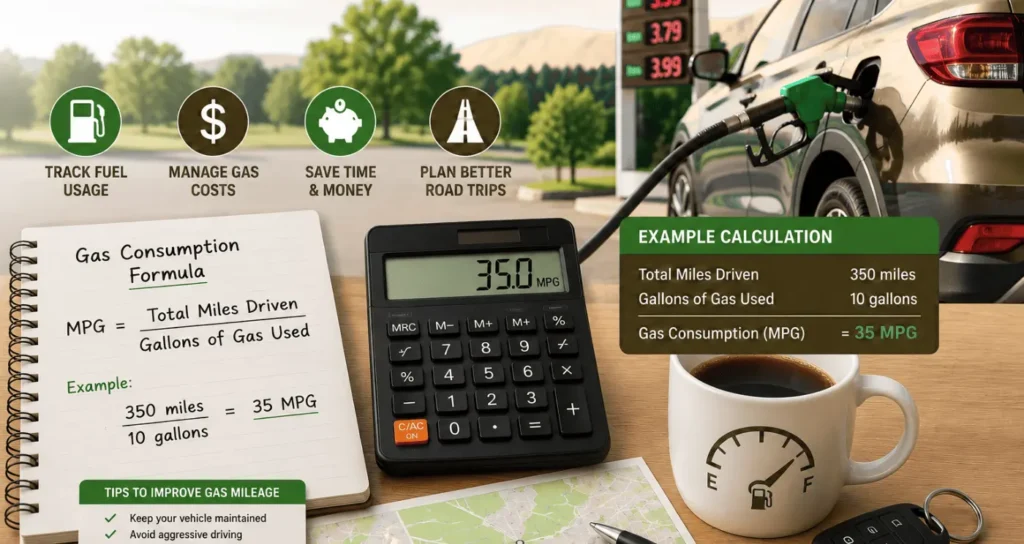
Step 6: Calculate Using the Given Formulas
Factors That Affect Gas Consumption
Driving Habits
Aggressive driving significantly increases fuel consumption. On the other hand, smooth driving tends to make a car more fuel-efficient.
Traffic Conditions
Traffic has a giant influence on the amount of gasoline consumed since traffic often requires constant acceleration and deceleration, which consumes more gasoline compared to a journey on the highway, where the speed does not change much and is smooth.
Vehicle Condition
Fuel usage is greatly affected by the condition of the car because bad maintenance leads to low fuel efficiency, but good maintenance of parts such as air filters, along with tuning up the engine, enables a smooth performance with high fuel efficiency.
Load and Weight
Loading weight and loads will impact your fuel efficiency because if you have many loads, the added weight is more work for your engine, and thus fuel use will be higher; conversely, having less weight improves performance.
Tire Pressure
Tire pressure is yet another crucial determinant in fuel economy, since low tire pressure increases rolling resistance, which in turn forces the engine to put in extra effort, thus increasing fuel consumption; on the other hand, optimal tire pressure helps maximize fuel economy.
Fuel Quality
However, fuel quality is another important factor that determines efficiency, as using poor-quality fuel may result in inefficient combustion, thus lowering the engine’s performance. On the other hand, good quality fuel makes the engine function more efficiently.
Tips to Reduce Gas Consumption
If you incorporate some practical techniques in your daily life, saving fuel can be basic. Smooth driving, avoiding jerky starts and stops, helps conserve fuel, while driving at a constant and moderate speed lets your car make efficient use of the fuel. Another important thing to keep in mind is to maintain proper air pressure in your tires, because it will help lower the amount of drag, which helps save fuel.
In addition, trimming down your load, i.e., making sure that there are no unnecessary objects in your car, can go a long way in helping you save fuel. Also, it’s not a dangerous idea to turn off your car engine when it is idle for a considerable length of time so that fuel doesn’t get wasted.
Common Mistakes to Avoid
Common mistakes to avoid include incorrectly computing the amount of fuel burned while moving around, which can lead to inaccurate values in your calculations. The omission of filling your car with fuel will result in wrong measurements and consequently give you incorrect figures. Ignoring various external factors like traffic and the nature of roads in relation to their effect on fuel consumption will not help you to get the correct figures because they are factors that affect your fuel consumption. In addition, the use of wrong figures related to the distance covered and the amount of fuel used will negatively affect your calculations.
Benefits of Tracking Gas Consumption
Fuel consumption tracking is important because there are many advantages associated with it. One of these is the ability to determine any variations in fuel consumption. You will get to know what kind of influence different factors can have on fuel efficiency. Moreover, by tracking your monitoring fuel consumption, you can notice any problems that may develop with your vehicle, as unexpected fluctuations can indicate something is wrong with your car. Lastly, it helps develop more effective driving skills since you become aware of the effect they have on fuel consumption.
Conclusion
Calculation of fuel consumption is among those competencies that every driver ought to have. Fuel consumption calculation is useful for not only making the driver aware of the behavior of their vehicle but also enabling him/her to organize future trips, budget the expenses on fuel, and change the style of driving accordingly. Using the clear-cut formulas given below, any driver will be able to calculate the fuel consumption.
Remember that slight alterations in the manner in which you operate your vehicle may bring a lot of difference. Start calculating your vehicle’s fuel consumption now and become an expert at the task.
FAQ’s
Q1. How can we calculate gas consumption easily?
This can be done through the following formula: Divide the total distance covered by the quantity of gas used. For instance, if we travel 200 km using 20 liters of gas, our consumption will be 10 km/liter.
Q2. Is there any relationship between the car’s speed and fuel consumption?
Yes, speeding will cause an increase in gasoline consumption. Driving at a consistent speed and at the right speed limit will help consume less fuel.
Q3. Do weather conditions affect fuel consumption?
Yes, harsh weather conditions, including excessive cold or heat, can affect the operation of the engine and make it consume more fuel.
Q4. Does the use of the air conditioner affect fuel consumption?
Yes, turning on the AC puts extra pressure on the engine; therefore, the fuel consumption increases.
Q5. Does the car’s age affect fuel consumption?
Yes, older cars use more gas because their engines don’t work as well.
Q6. Will the fuel consumption calculation be different for bicycles or trucks?
No, the formula will remain the same regardless of whether you use a truck or a bicycle. Just divide the miles covered by the fuel used.